WHERE THOREAU LIVED, WROTE, AND WALKEDI
What did Thoreau actually do at Walden Pond?
A visitor's guide to Walden Pond, the kettle hole where Thoreau built his cabin and wrote his famous book.
The answer in fullII
Read on
Why it matters
Walden Pond is a small, deep pond in the woods on the edge of Concord and Lincoln, known well beyond its modest size because of one book. Henry David Thoreau lived in a cabin on its northern shore for two years starting in the summer of 1845, and his account of that time, Walden; or, Life in the Woods, published in 1854, made this pond one of the best-known bodies of water in American literature.
The pond lies within Walden Pond State Reservation, 335 acres managed by the state's Department of Conservation and Recreation. It was designated a National Historic Landmark in 1962 for its association with Thoreau, and the National Historic Preservation Act of 1966 secured federal support for its ongoing care. Visitors come for both reasons at once, a literary pilgrimage and a local swimming place.
On a summer day it leans heavily toward the swimming side. Families spread towels on the beach, swimmers cross the deep water, and the crowd thins only toward evening. Anyone hoping for the quiet woods Thoreau described should plan a visit outside the warmest months, or come at the edges of the day.
A kettle hole
The pond is a textbook kettle hole, formed when retreating glaciers left a block of buried ice in the ground some ten to twelve thousand years ago. As the ice melted it left behind a deep, steep-sided basin that slowly filled with water. The result covers about sixty-four acres, with no visible inlet or outlet feeding it.
The absence of a stream puzzled Thoreau himself, who wondered whether an unseen spring fed the pond from below. In the chapter of Walden called The Ponds, he describes its clarity, its changing color and temperature, the stones on its bed, and its mirror-like surface on still days, along with the fish and birds he observed there.
He also records a local story that the pond took its name from a woman who alone survived when a hill sank on the spot, and the tale of an old man who had fished the pond decades earlier from a clumsy canoe of two pine logs pinned together, a boat the man said belonged to the pond itself. Parts of the shore are sandy beach, while elsewhere the banks drop steeply from the trails to the water, so footing deserves attention on the full loop.
Thoreau's two years
The land at the pond's north end belonged to Ralph Waldo Emerson, Thoreau's friend and mentor, who let him use it for what Thoreau called his experiment in living simply. Thoreau built a one-room house there and lived in it from 1845 to 1847, growing beans, reading and writing, and walking the woods around the water.
The area around the pond was then neglected and heavily used, sitting just outside town: the earth nearby had been mined, and the town dump would later stand across the road. Formerly enslaved people had also lived on the common land close by, which was not the untouched wilderness a modern visitor might expect.
Thoreau was inspired by one of them, Zilpah White, who lived alone in a one-room house on Walden Road and made her living spinning flax. In his first winter at the pond, he also watched a large gang of men arrive by train and cut ice from its surface for sixteen days, ice later shipped from Boston to ports as far away as India, and he wrote about the scene in his journal.
The site of his house, a short walk north of the water, is marked today by a series of granite posts outlining its small footprint. Standing there, with the pond visible through the trees, gives a clearer sense of the place than any photograph or sign at the reservation can offer.
Saving the woods
Descendants of Emerson and other families gave the land around the pond to the Commonwealth in 1922, establishing the reservation that protects it today. An amusement park at the western end, complete with swings and an event hall, had burned down in 1902 and was never rebuilt, leaving that shoreline to return to woods.
In 1961 the county commissioners then managing the land began leveling woodland for parking and other improvements. They were sued, and the Superior Court ruled that the original deed required the landscape to be preserved rather than developed, a decision that still shapes how the reservation is managed today, decades later.
In 1990 the musician Don Henley started the Walden Woods Project to stop further development in the woods around the pond. Working with the Trust for Public Land and the Commonwealth, the project permanently protected more than eighty-five additional acres, including Bear Garden Hill, where Thoreau took walks by moonlight.
In 1995 the project helped buy a historic house that became the research center and library of the Thoreau Institute, a resource for anyone studying his life and writing in more depth than a single visit allows. Visitors interested in the archive should contact the institute directly about access and current hours.
What you see today
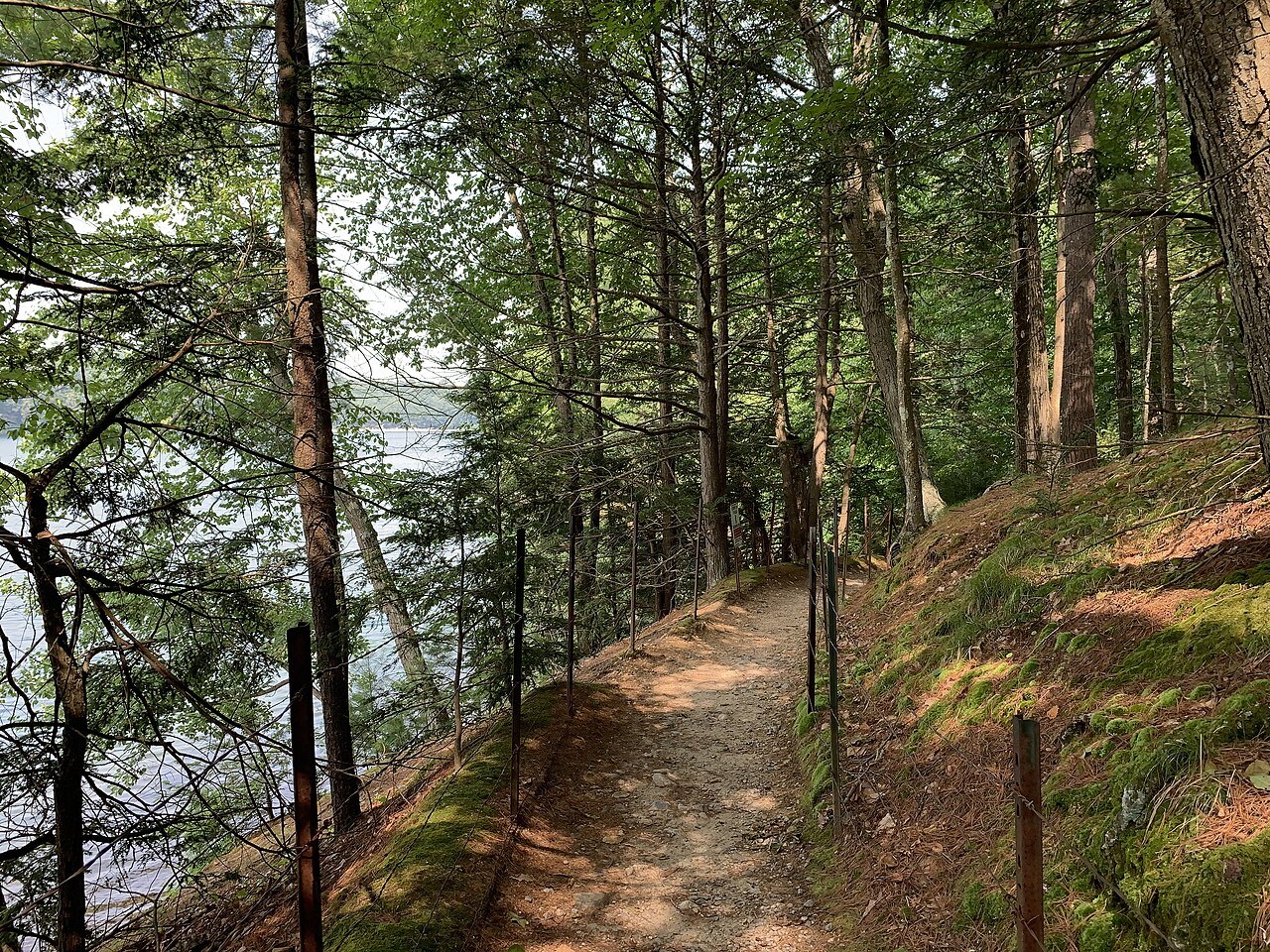
From the parking area across Route 126, a ramped path leads down to the main beach on the southeastern shore, where three buildings stand. From there a trail circles the pond, running along the water and up and down steep banks to the cabin site on the north side; the loop is an easy walk for most visitors.
A replica of Thoreau's cabin stands at the reservation, giving a sense of the small one-room house he actually built, distinct from the marked site of the original on the north shore. The visitor center, designed by Maryann Thompson and opened in 2016, was built to run without fossil fuel.
The reservation welcomes visitors all year for day use, with swimming in summer and boating, fishing, birdwatching, walking and picnics possible in other seasons; camping is not allowed anywhere on the property. Visitors should check current rules on swimming and boating directly with the reservation before planning a trip around them.
The Fitchburg commuter rail line runs past the pond's west side, and the nearest station is in Concord center, a walk of about a mile and a half from the water. The parking lot itself was laid in 1977 as a demonstration of porous pavement and still functions well, despite far more freezing and thawing than most places see. Check current schedules with the MBTA before planning a trip by train.
How to visit
Come early in the day in summer, when the beach draws the largest crowds and parking fills first; check seasonal conditions before planning a trip. In spring, autumn and winter the pond is far quieter, and walking the full loop becomes the main reason to come rather than a stop on the way to the water.
Reading The Ponds chapter beforehand, or bringing the book along, adds real depth to a walk here. Standing at the granite posts marking the cabin site, with the water visible through the trees, makes far more sense of Thoreau's writing than any sign or placard at the reservation ever can.
The pond combines well with other Concord sites: the North Bridge, the Wayside, and the houses of Emerson and the Alcotts are all a few minutes away by car. Together they make a full day of New England literary and revolutionary history, including the battlefield sites protected within Minute Man National Historical Park.
Read nextIII
More from the journal
- Lexington, Concord and the Old North BridgeWhat was the shot heard round the world?The phrase behind the North Bridge, Daniel Chester French's statue, and how to see the ground where it happened.Read the piece →
- Lexington, Concord and the Old North BridgeWhat happens on Patriots' Day in Massachusetts?Patriots' Day marks the first battles of the Revolution on April 19, 1775. On the third Monday in April, Lexington and Concord reenact them at dawn, riders retrace Paul Revere's ride, the Boston Marathon runs from Hopkinton to Boylston Street and the Red Sox play at home. How to see it, and how to plan around it.Read the piece →
- USS Constitution and Bunker HillHow did USS Constitution get the name Old Ironsides?How a War of 1812 victory over Guerriere gave USS Constitution her famous nickname, and how to visit her in Charlestown.Read the piece →