THE THIRD MONDAY IN APRILI
What happens on Patriots' Day in Massachusetts?
Patriots' Day marks the first battles of the Revolution on April 19, 1775. On the third Monday in April, Lexington and Concord reenact them at dawn, riders retrace Paul Revere's ride, the Boston Marathon runs from Hopkinton to Boylston Street and the Red Sox play at home. How to see it, and how to plan around it.
The answer in fullII
Read on
The short answer
Patriots' Day is a Massachusetts holiday that commemorates the battles of Lexington, Concord and Menotomy on April 19, 1775, the first battles of the American Revolutionary War. Since 1969 it has been observed on the third Monday in April, which makes a long weekend, and it is the first day of the school vacation week in Massachusetts.
For a visitor it is one of the most memorable days of the year to be in the state. Before dawn the militia companies muster on Lexington's Battle Green to reenact the first shots; later in the morning the fight at the North Bridge in Concord is replayed; mounted riders retrace the night rides of Paul Revere and William Dawes; and at midmorning the Boston Marathon starts in Hopkinton, twenty-six miles west of Boylston Street.
Why the day exists
On the night of April 18, 1775, two lanterns were hung in the steeple of the Old North Church in Boston to warn that British troops were moving, and Paul Revere and William Dawes rode out to raise the countryside. At dawn on April 19 the regulars met the militia on Lexington's green; later that morning they were turned back at the North Bridge in Concord, and on the long march back to Boston the heaviest fighting of the day came in Menotomy, now the town of Arlington.
In 1894 Lexington and Concord each asked the state to name the day for their own town. Governor Frederic Greenhalge chose a compromise, Patriots' Day, and proclaimed it that year in place of the old Fast Day holiday. It was first held on April 19 itself; the move to a Monday came in 1969.
The reenactments
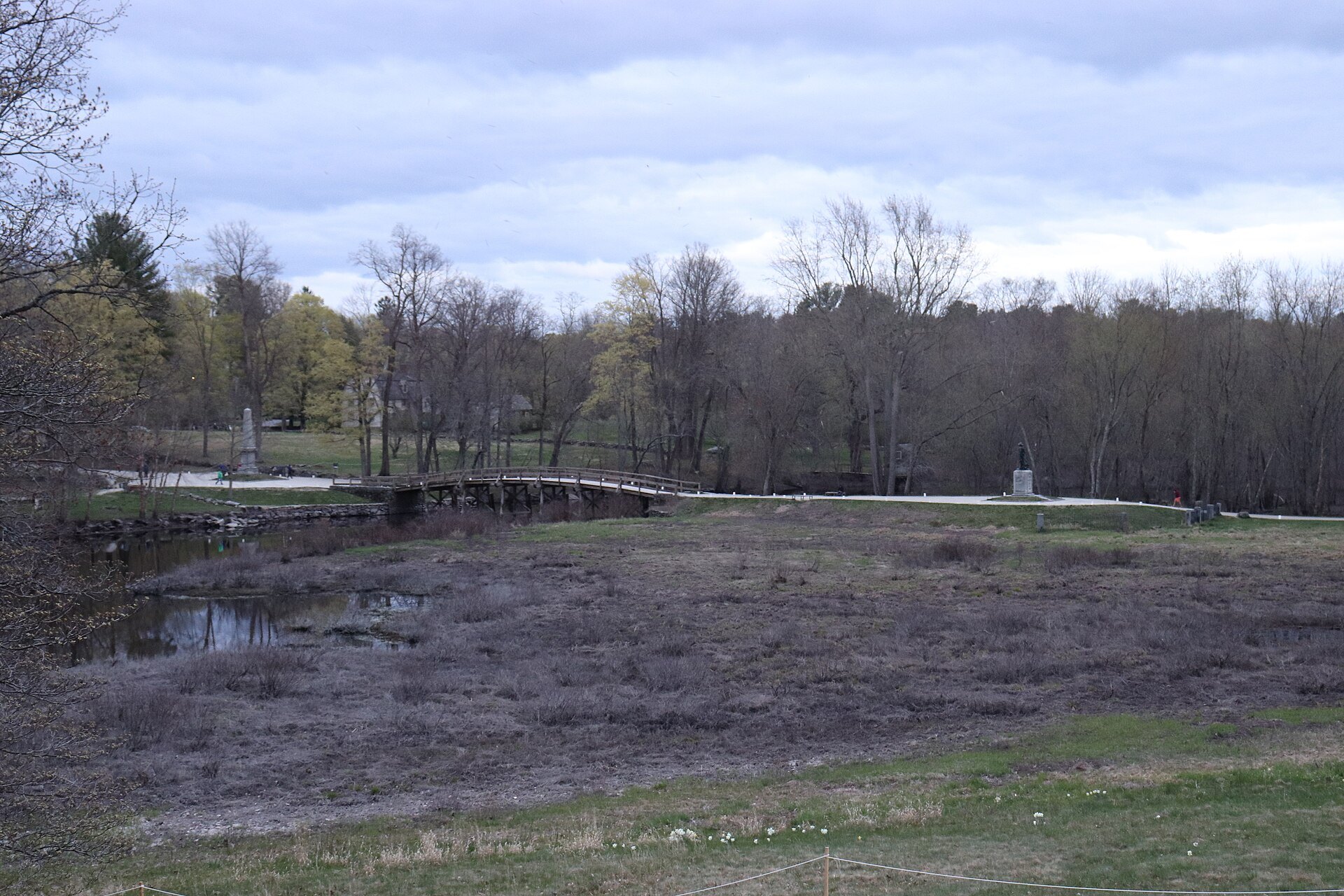
The heart of the day is the reenactments. At Lexington's Battle Green the militia and the regulars meet again very early in the morning, before sunrise, in front of crowds who arrive in the dark; the Concord fight at the Old North Bridge follows later in the morning. Arlington holds its own on the Sunday before the holiday, and the Jason Russell House, where some of the fiercest fighting took place, offers tours on the Sunday and the Monday.
In all, up to sixty events take place across the holiday weekend, with battle reenactments in Boston, Cambridge, Arlington, Medford, Lexington, Concord and Lincoln, parades in Lexington, Concord, Boston, Bedford and Arlington, tours of historic houses and pancake breakfasts. On Monday morning, mounted reenactors escorted by the state police retrace the rides of Revere and Dawes, calling out warnings the whole way.
Menotomy, the forgotten battle
The biggest fight of April 19 was neither at Lexington nor at Concord but in Menotomy, on the Concord road between Lexington and Boston, where the fighting grew more intense as the retreating regulars and their reinforcements marched through; the largest engagement of the day took place on the farm of Jason Russell at the center of the town, and far more blood was shed there and in Cambridge than anywhere else. It is less well known partly because the town has changed its name more than once since 1775; today it is Arlington.
That is why the holiday has the name it does. When Lexington and Concord each asked to have the day named for them, Governor Greenhalge chose Patriots' Day to take in every town along the road, and Arlington keeps the day with its own reenactment and parade.
The Boston Marathon
The biggest event of the day is the Boston Marathon, run on Patriots' Day since April 19, 1897, a year after the first Olympic marathon, which makes it the oldest annual marathon in the world. It has been organized by the Boston Athletic Association since the beginning and is one of the World Marathon Majors. Its course runs through eight cities and towns, Hopkinton, Ashland, Framingham, Natick, Wellesley, Newton, Brookline and Boston, and finishes on Boylston Street near Copley Square.
More than half a million spectators line the route, making it New England's most watched sporting event. The hardest part of the course is the four Newton hills, ending in Heartbreak Hill near Boston College just after the twentieth mile, and it is a favorite place to watch and cheer. The finish in the Back Bay is the most crowded; stand farther out for a better view.
The Red Sox game
The Boston Red Sox have been scheduled to play at home at Fenway Park on Patriots' Day every year since 1959. From 1968 to 2006 the game started in the morning and ended just as the runners came through Kenmore Square; since the marathon's start moved later in 2007, the runners pass Kenmore closer to the middle of the game.
How to see it
Choose one part of the day, or two that fit together. For the reenactments, stay in or near Lexington or Concord the night before, or plan an early drive, since the Lexington muster starts before sunrise. For the marathon, take the T to a point along the route, in Newton, Brookline or Kenmore Square, and move on to the finish afterward. The Battle Road through Minute Man National Historical Park links Lexington and Concord along five miles of the route the regulars took, and a morning at the reenactments can be followed by an afternoon at the North Bridge and Walden Pond.
Planning around it
If you are not coming for the day, plan around it. Boston is at its busiest on the marathon weekend, the roads along the course close for the race, and the Back Bay near the finish is crowded for much of the day. Public schools across the state take the following week off, so museums and family sights are busier than usual. The weather in mid-April is changeable, often cool and wet, so dress in layers, especially for a dawn start on Lexington's green; see When to Come.
Beyond Massachusetts
Maine, which was part of Massachusetts until 1820, followed in 1907 and also observes the day on the third Monday in April. Several other states have since recognized it, some on April 19 itself. But it is in the towns along the road from Boston to Concord that the day belongs, and where it is kept most fully. For the rest of the story in Boston, walk the Freedom Trail to the Old North Church, where it began.
Read nextIII
More from the journal
- The Freedom TrailHow long does it take to walk the Freedom Trail?The Freedom Trail is only two and a half miles long, but its sixteen stops can fill a day. How long the walk takes with and without the buildings, where to break it in two, which stops need the most time, and how to get back from Charlestown at the end.Read the piece →
- Getting HereHow do you get from Logan Airport to downtown Boston?Logan sits in East Boston, across the harbor from downtown, so every route into the city crosses the water. The Silver Line bus to South Station, the Blue Line from Airport station, the Logan Express, the boats and the car through the Ted Williams Tunnel, and which suits where you are staying.Read the piece →
- Ferries & IslandsHow do you get to Martha's Vineyard, and do you need a car?Martha's Vineyard has no bridge: you arrive by ferry or small plane. Which harbor to sail from, the one ferry line that takes cars, why most visitors leave the car behind, and how to get round the island by bus, bicycle and on foot.Read the piece →