THE UNSOLVED HEISTI
What was stolen from the Gardner Museum in 1990?
The story of the 1990 theft at the Gardner Museum, what was taken, and why the gaps remain unfilled today.
The answer in fullII
Read on
The morning of March 18, 1990
Early on March 18, 1990, two men disguised as police officers gained entry to the Isabella Stewart Gardner Museum and tied up the two night guards on duty. Over the following hour they moved through the galleries, cutting some paintings from their frames and carrying others away whole, taking thirteen works in all before leaving the building undetected.

The theft is described as the greatest known property theft in history, a theft that has never been matched in scale or value since. More than three decades on, the case remains unsolved, and not one of the thirteen works has been recovered or returned to the galleries it was taken from.
No suspects have ever been publicly identified, and the museum's own account of the event adds little beyond the bare facts: two men, a disguise, a single night. That silence is part of what has kept the case active in public memory, discussed by visitors standing in the same rooms the thieves walked through.
What was taken
Among the stolen works were Vermeer's The Concert, one of only thirty-four paintings known to survive by the artist, and Rembrandt's The Storm on the Sea of Galilee, the only seascape he is known to have painted. Both had hung in the Dutch Room, one of the most carefully arranged galleries in the house.
The museum has not published a complete room-by-room account of all thirteen works within the text available to visitors, and anyone wanting the full list, images of the missing pieces or the latest detail on the case should check the museum's own site or ask staff directly when planning a visit.
The thirteen works taken that night ranged across painting, drawing and decorative objects rather than a single category, reflecting the breadth of Gardner's own collecting across Europe, Asia and America. Their absence is felt unevenly through the house, concentrated most heavily in the Dutch Room where several of the most valuable pieces once hung together.
Why the loss still matters
Gardner assembled her collection herself, often guided by the scholar Bernard Berenson, who in 1894 offered to find her a Botticelli. She was choosing Rembrandt, Vermeer, Titian and others not as a curator building a survey of art history but as a collector filling a house she meant to live in and later leave to the public.
Losing two such rare paintings broke a set of relationships between objects that she had spent decades arranging by eye, room by room, so that paintings, sculpture, tapestries and furniture sat together as they might in a private home rather than in the chronological order a museum curator would choose.
The Dutch Room where the Vermeer and Rembrandt once hung sits among rooms that still hold Rembrandt's self-portrait at the age of twenty-three and other major works, so a visitor today sees in close succession both what survived the theft and, on the same walls, what was lost to it, a contrast found nowhere else in the city.
The house built around the collection
Gardner built the house she called Fenway Court between 1898 and 1901, after her husband's death, on marshy land near the Back Bay Fens, modeling it on the Renaissance palaces of Venice. Her architect was Willard T. Sears, though she was so involved in every detail that he joked he was only the structural engineer who made her plans possible.
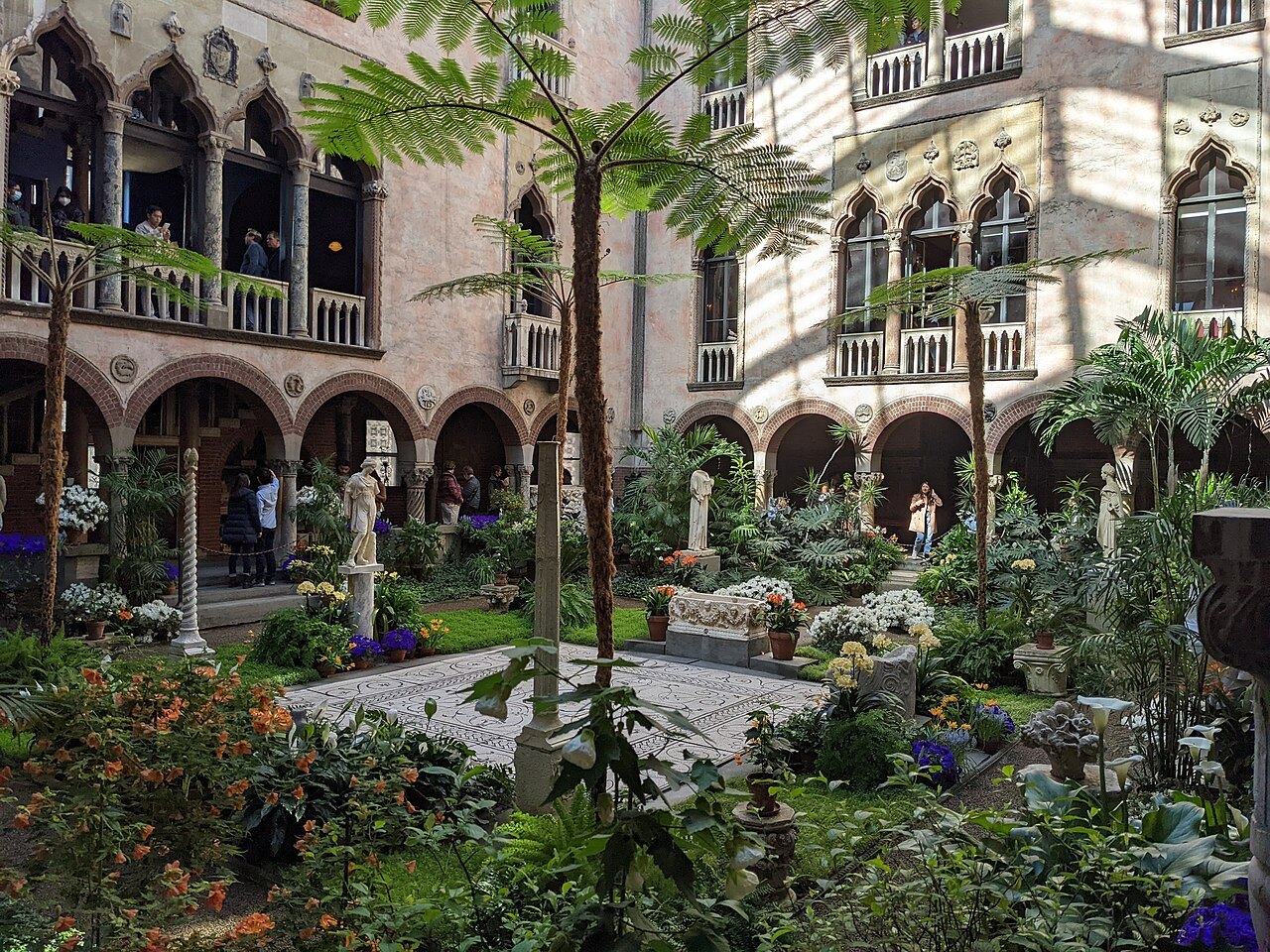
At the center of the building is a courtyard three stories high under a glass roof whose steel structure is original to the house, its floor laid with a Roman mosaic and its planting changed through the year to follow Gardner's own tastes in gardening, so that something is in flower in every season.
Every gallery, including the Dutch Room, opens onto this courtyard through Venetian windows and balconies, and the building is designed to be walked around it. That design has not changed since the theft; the courtyard remains the place where a visit begins and to which it returns between the darker, crowded rooms.
The empty frames
Gardner's will required that the collection be kept and displayed exactly as she arranged it, for the education and enjoyment of the public, permanently. That clause shaped how the museum responded after the theft: rather than rehang the Dutch Room to disguise the loss, it left the frames in place on the walls.
Empty frames still hang in the Dutch Room today, marking exactly where the Vermeer, the Rembrandt and the other missing pieces once hung. They are not a memorial added later but the literal absence of the paintings, kept visible because the will does not allow the rooms to be rearranged around the gap.
Other large works throughout the house still hang in a frame within a frame, held with thumbscrews the way Gardner herself fixed them, a reminder that the empty frames in the Dutch Room follow the same rule of fixed arrangement rather than being an exception made for the theft of 1990.
The investigation and the reward
The theft has never been solved, and no arrests have been made public in the years since it happened. The museum continues to offer a reward for information leading to the recovery of the thirteen works, a standing invitation to anyone who might know where they ended up, whether locally or abroad.
In May 2017 the museum raised that reward to double its original amount, a sign that the institution treats the case as active rather than closed. The amount itself, and the exact terms for a claim, are matters to check directly with the museum rather than assume from other sources.
Anyone with information is directed to the museum's own channels, published on its site, rather than to general visitor services or ticketing. The museum, not the police department alone, has kept the appeal visible to the public for more than three decades, through every anniversary of the theft that passes.
Visiting the Gardner today
A visit to the museum still begins in the courtyard and moves out into the surrounding galleries, including the Dutch Room with its empty frames. The new wing, completed in 2012 to a design by the Pritzker Prize-winning architect Renzo Piano, holds visitor services, concerts and exhibitions, taking pressure off the historic rooms. See the museum's full visitor page for the layout and the rest of the collection.
Tickets are sold by the museum, which often uses timed entry, so check its own site before going rather than assuming availability. Allow at least two hours, since both the surviving masterpieces and the gaps left by the theft reward slow, unhurried looking rather than a quick pass through the rooms.
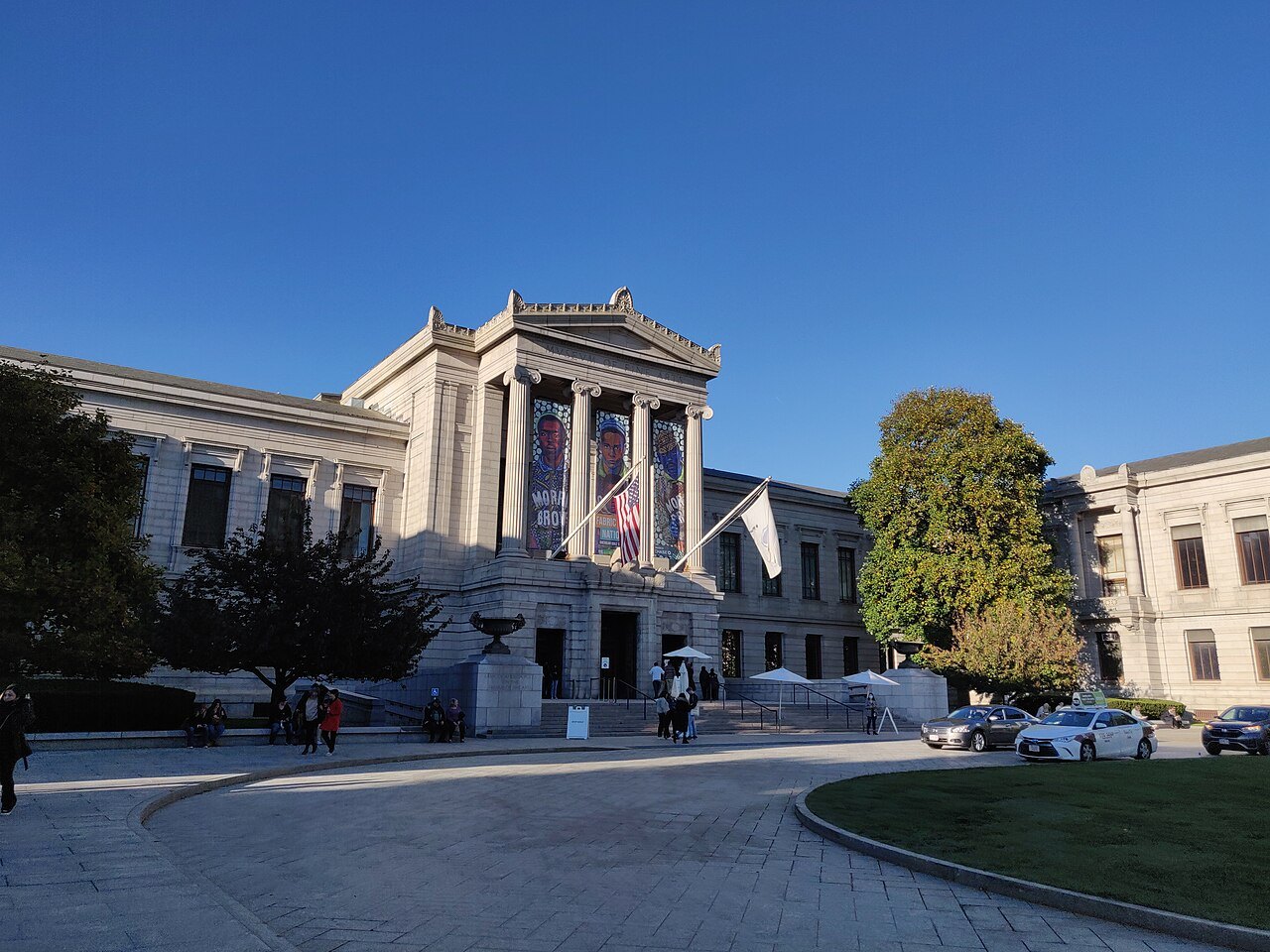
The Museum of Fine Arts stands a few minutes' walk away on Huntington Avenue, and the two institutions together make a full day in the Fenway for visitors interested in both the encyclopedic collection there and the single collector's vision preserved at the Gardner, empty frames included, a contrast worth seeing in the same visit.
Read nextIII
More from the journal
- The Freedom TrailWhat happened at the Old South Meeting House before the Tea Party?How a plain Puritan meeting house became the hall where Boston decided to throw British tea into the harbor.Read the piece →
- The Freedom TrailHow long does it take to walk the Freedom Trail?The Freedom Trail is only two and a half miles long, but its sixteen stops can fill a day. How long the walk takes with and without the buildings, where to break it in two, which stops need the most time, and how to get back from Charlestown at the end.Read the piece →
- USS Constitution and Bunker HillHow did USS Constitution get the name Old Ironsides?How a War of 1812 victory over Guerriere gave USS Constitution her famous nickname, and how to visit her in Charlestown.Read the piece →