WHY DUCKLINGS LIVE IN THE GARDENI
Why is Make Way for Ducklings in the Public Garden?
The story behind Nancy Schön's bronze duck family near the Public Garden's Charles Street gate.
The answer in fullII
Read on
A duck family in a city garden
Near the gate where Charles and Beacon Streets meet the Public Garden, eight small bronze ducklings trail behind their mother, Mrs. Mallard. Nancy Schön cast the group in 1987, setting each figure low on the path rather than on a pedestal, so children can walk among them instead of looking up. The spot sits at the corner nearest Beacon Hill, one of the gates most visitors use when crossing over from Boston Common.
The bronzes exist because of a story, not the other way around. The ducklings take their name and their line of march from Robert McCloskey's children's book, in which a mallard family leaves the Charles River and settles on the Public Garden lagoon after a walk through city streets that a police officer helps to clear. The statues fix that story to one exact spot of ground.
Visitors reach the ducklings on foot only; the Garden has no vehicle access and no gate to pass through to see them. They stand close to the Beacon Street side, a short walk from the Arlington Street and Charles Street entrances used for the rest of the Garden, close enough to Boston Common that one stop can take in both parks without doubling back.
The book behind the statues
Robert McCloskey's Make Way for Ducklings follows Mrs. Mallard and her brood as they look for a home, settling at last on the Public Garden lagoon rather than the busy Charles River nearby. The book has stayed in print for decades and is read to generations of Massachusetts children long before most of them ever see the real pond.
Nancy Schön's sculpture turns the book's final march into bronze: Mrs. Mallard leads, and eight ducklings follow in a line behind her, each one scaled slightly smaller than the one before. The group has stood near the Charles and Beacon Streets gate since 1987 and has become one of the most photographed things in the Garden.
The statues sit directly on the path rather than behind a rail, which invites handling as much as viewing and is part of why they draw families in particular. From this gate the straight path across the Garden leads toward Arlington Street, while the winding paths lead past the lagoon itself, the pond the ducklings were drawn to in the story.
The Public Garden around them
The Public Garden is Boston's oldest public botanical garden, established in 1837 on land that had been salt marsh at the edge of the Back Bay. The city bought the land back from ropemakers in 1824, and the philanthropist Horace Gray later petitioned for its use as a garden rather than a building site. Pressure to sell the land for construction went on for two decades.
An agreement of 1856 between the city and the Commonwealth, approved by a lopsided public vote, finally barred building on the land for good. The plan that followed, approved in 1859, was designed by George F. Meacham, with paths and flower beds laid out by the city engineer James Slade and the city forester John Galvin. The Garden covers twenty-four acres in total.
An iron fence enclosed the Garden by 1862, and a straight path crosses it between the Charles Street and Arlington Street entrances; every other path winds rather than runs straight, a layout meant to slow a stroll rather than shorten it. The equestrian statue of George Washington, by Thomas Ball and dated 1869, faces Commonwealth Avenue from the western entrance.
Paths through the Garden are lined with European and American elms, horse chestnuts, dawn redwoods, beeches and ginkgos, planted long after the first flower beds went in. The effect, compared with the open ground of Boston Common next door, is deliberately close and shaded, built for slow walking rather than for gathering or speeches.
The lagoon, the bridge and the boats
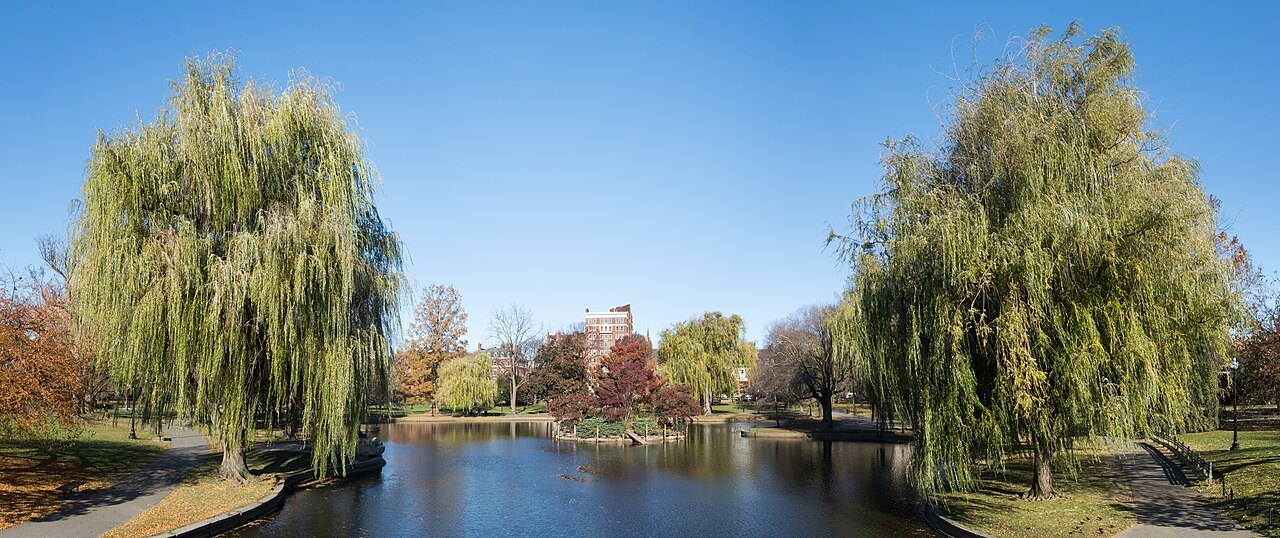
The pond at the center of the Garden, usually called the lagoon, is ringed with weeping willows and was finished in 1859, the same year the plan was approved. Its island on the north side was once a peninsula; the city forester cut it off from the shore because it had become too popular with courting couples.
Across the middle of the lagoon runs a footbridge designed by William G. Preston, opened on June 1, 1867 and once the world's shortest working suspension bridge, before it was converted to a girder bridge in 1921. It still gives the shortest way across the water for anyone walking the winding paths rather than the straight one.
Below the bridge, the Swan Boats, pedaled from the stern behind a large white swan, have carried passengers around the lagoon since 1877, close to where the bronze ducklings imagine their own swim. A visitor wanting the schedule, route or boarding point for the boats should check directly with the operator rather than assume a fixed routine.
How to visit
Both the Public Garden and Boston Common are public ground with no gate to pass and no admission to arrange; a visitor can walk in from any side. The usual approach to the ducklings is through the gate at Charles and Beacon Streets, a short walk from Beacon Hill and from the Common's own paths.
Sitting on the grass is allowed in both parks except where a posted sign forbids it, so a picnic near the lagoon is ordinarily possible. The Frog Pond on the Common nearby changes with the season, an ice rink in winter and a spray pool in summer; check which one is set up before planning a visit around it.
A single visit can cover both parks without much backtracking: enter the Garden from Charles Street, pass the ducklings and the lagoon, and leave by the Arlington Street gate toward Commonwealth Avenue, or step back onto the Common to pick up the Freedom Trail, which begins near the Tremont Street visitor center.
Boston Common next door
Boston Common lies just across Charles Street from the Garden and is the oldest city park in the United States, fifty acres bounded by Tremont, Park, Beacon, Charles and Boylston Streets. Where the Garden is fenced and planted for strolling, the Common is broad open ground with a long public history as pasture, training field and gathering place.
At the Common's northeast corner stands the Robert Gould Shaw Memorial, honoring Shaw and the Black soldiers of the 54th Massachusetts Volunteer Infantry, and at its heart the Frog Pond changes by season as described above. The Common is also the start of the Freedom Trail and the first link in the Emerald Necklace of parks running south through the city.
For a visitor following the ducklings' own route, as the book tells it, the Common sits across Charles Street in the direction of the State House, while the Garden's lagoon and the bronze family themselves sit only steps from where the two parks meet, making them one of the easiest stops to combine with a longer walk of Boston.
Read nextIII
More from the journal
- Boston Common and the Public GardenHow do the Swan Boats in the Public Garden work?A visitor's guide to the Public Garden's pedal-powered Swan Boats, the lagoon they circle, and how to plan a ride.Read the piece →
- The Freedom TrailHow long does it take to walk the Freedom Trail?The Freedom Trail is only two and a half miles long, but its sixteen stops can fill a day. How long the walk takes with and without the buildings, where to break it in two, which stops need the most time, and how to get back from Charlestown at the end.Read the piece →
- Getting HereHow do you get from Logan Airport to downtown Boston?Logan sits in East Boston, across the harbor from downtown, so every route into the city crosses the water. The Silver Line bus to South Station, the Blue Line from Airport station, the Logan Express, the boats and the car through the Ted Williams Tunnel, and which suits where you are staying.Read the piece →