A BOULDER, A LEGEND AND A PORTICOI
Is Plymouth Rock really where the Pilgrims landed?
Plymouth Rock is honored as the Pilgrims' landing place of December 1620, but neither of the colony's own chroniclers mentions it, and the claim was first made in 1741. How the legend began, how the rock was split, moved and rejoined, and what to see in Plymouth when you go.
The answer in fullII
Read on
The short answer
Nobody knows. Plymouth Rock is a boulder on the shore of Plymouth harbor that has been honored since the eighteenth century as the place where the Mayflower Pilgrims stepped ashore to found Plymouth Colony in December 1620. But the two most important first-hand accounts of the colony, Edward Winslow's Mourt's Relation of 1622 and William Bradford's history Of Plymouth Plantation, never mention a rock at all.
The first documented claim came in 1741, 121 years after the landing, and many historians doubt it. What is certain is that the rock has been split, moved, rejoined and chipped over the centuries, and that it is now a symbol rather than a piece of evidence. It is still worth seeing, and the story of how it became famous is part of the story of how Americans came to remember the Pilgrims.
How the legend began
The rock first attracted attention in 1741, when the people of Plymouth began plans to build a wharf that would bury it. Before the work began, Thomas Faunce, a church elder of ninety-four, declared that this boulder was the landing place of the Pilgrims. He had it from his father, who had arrived in the colony aboard the ship Anne in 1623, three years after the Mayflower, and Faunce himself was born in 1647, when many of the Mayflower passengers were still alive.
His claim made a strong impression. He is said to have pointed out the rock directly under the bank of Cole's Hill, told the crowd what his father had told him, and bid it a tearful farewell. The wharf was built, and the rock stayed where it was, raised up and partly buried, as the town's landing place.
Split, moved and rejoined
In 1774, on the eve of the Revolution, Theophilus Cotton and the townspeople decided to move the rock to the town square as a patriotic emblem. It split in two as they tried. The bottom part was left behind at the wharf, and the top part was hauled to the town's meeting house, and in 1834 to Pilgrim Hall Museum.
At the wharf, the Pilgrim Society built a Victorian canopy designed by Hammatt Billings over the lower half, begun in 1859 and completed in 1867. In 1880 the top half was brought back from Pilgrim Hall, rejoined to the rest, and the date 1620 was carved into it. Along the way many pieces were chipped off and sold; some are now in Pilgrim Hall Museum and in the Smithsonian's National Museum of American History, although none has noticeably been removed since 1880.
The portico of 1920
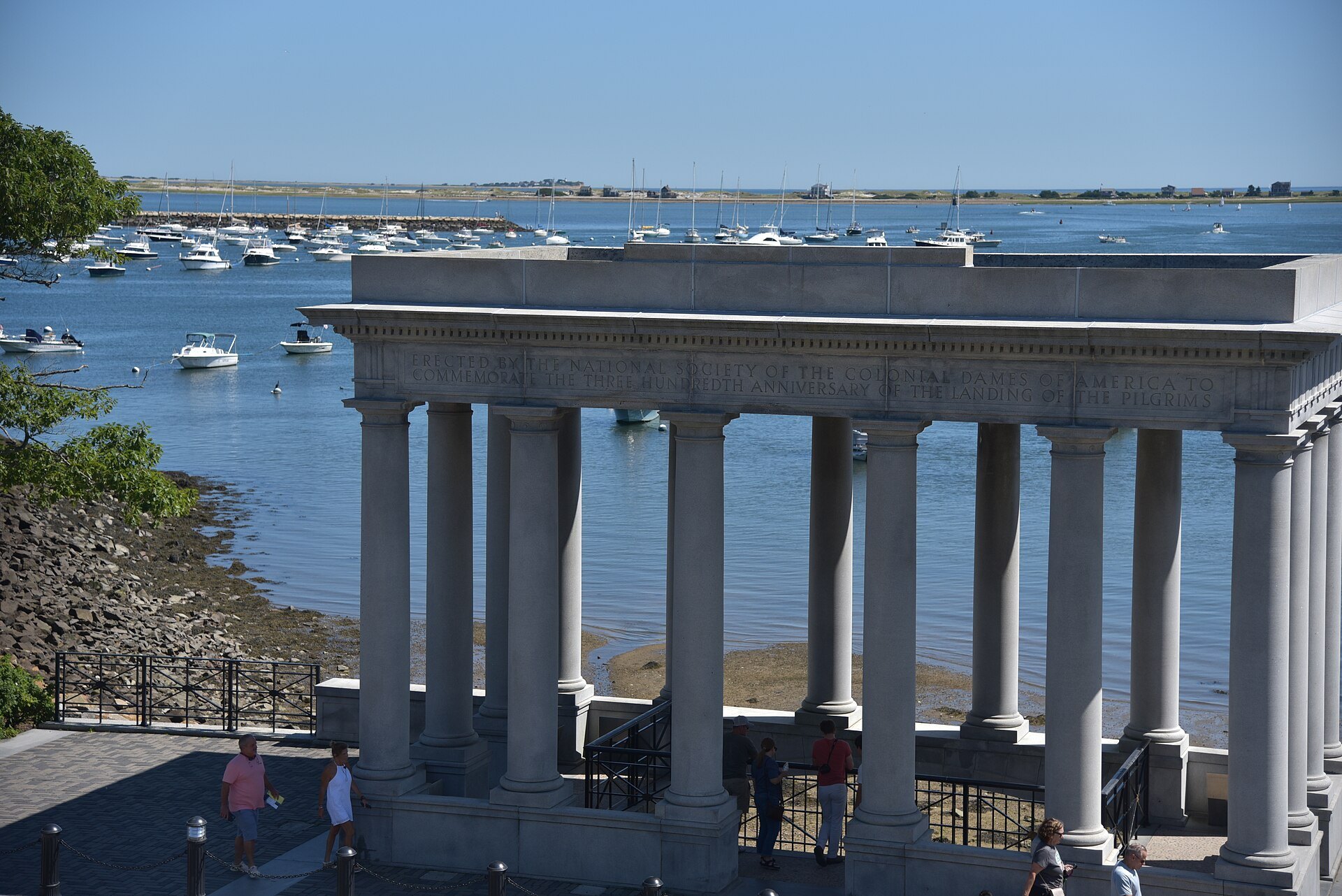
For the three hundredth anniversary of the landing, in 1920, the rock was lifted while the old wharves were removed and the waterfront landscaped to a design by Arthur Asahel Shurcliff, with a promenade behind a low seawall. The rock was put back on its site at water level, where the tide can wash it, and the Commonwealth took over its care. Over it rose a new Roman Doric portico designed by McKim, Mead and White, from which visitors look down on the rock through gratings.
Today it is part of Pilgrim Memorial State Park, managed by the state Department of Conservation and Recreation, the smallest park in the state's forest and park system and also its most heavily visited.
A national relic
By the early nineteenth century the rock had become a national symbol. When the French writer Alexis de Tocqueville described the United States in 1835, he noted that the rock had become an object of veneration, and that he had seen bits of it carefully preserved in towns across the Union, treasured by a great nation because the feet of a few outcasts had pressed it for an instant. The pieces sold off over the years went into homes, museums and souvenirs all over the country, which is one reason the rock is so much smaller than it once was.
The doubts
The doubts are about the evidence, not about the Pilgrims. Neither Winslow nor Bradford mentions the rock, the claim was made more than a century later from family memory, and the rock itself has moved several times, so even its present site is not quite where it was. The writer Bill Bryson put the skeptics' view plainly: whatever the Pilgrims did, stepping ashore on a boulder would have been an impractical way to land.
There is also the question of which landing counts. The Pilgrims first came ashore at the tip of Cape Cod, at what is now Provincetown, more than a month before they reached Plymouth harbor, and signed the Mayflower Compact there. In 1851 a group of Cape Cod residents formed the Cape Cod Association to promote Provincetown as the true site of the first landing, and their efforts led in the end to the Pilgrim Monument, completed in 1910.
Seeing it
The rock lies on the waterfront in the center of Plymouth, under its granite portico beside the harbor, and it can be seen at any time from the portico above. Above it rises Cole's Hill, where a sarcophagus holds the bones of the Pilgrims who died in the first winter, and a short walk along the shore brings you to the Mayflower II, the full-size reproduction of the ship. Pilgrim Hall Museum, the oldest continually operating museum in the country, keeps a piece of the rock among its collections.
A day in Plymouth
Pair the waterfront with Plimoth Patuxet, the living history museum outside the town center, which recreates the colony as it stood in 1627 beside a Wampanoag Homesite and tells the story from both sides of the shore. Plymouth also stands on the road from Boston to Cape Cod, so it makes a natural stop on the way to the canal, and in autumn the cranberry bogs of the surrounding country are flooded for the harvest.
Whatever you decide about the rock itself, it marks the right place to begin: the harbor where the colony was built, on the site of the Wampanoag village of Patuxet, in the town that calls itself America's Hometown. For the Pilgrims' later story and the long drive out to where they first came ashore, see Cape Cod National Seashore.
Read nextIII
More from the journal
- Cape Ann: Rockport and GloucesterWhy is Motif Number 1 the most painted building in America?A plain red fishing shack on Bradley Wharf in Rockport is called the most often-painted building in America. Why painters chose it, how it got its name, why the one you see is a replica built after the Blizzard of 1978, and how to see it and the rest of Cape Ann's painters' coast.Read the piece →
- The Freedom TrailHow long does it take to walk the Freedom Trail?The Freedom Trail is only two and a half miles long, but its sixteen stops can fill a day. How long the walk takes with and without the buildings, where to break it in two, which stops need the most time, and how to get back from Charlestown at the end.Read the piece →
- Lexington, Concord and the Old North BridgeWhat happens on Patriots' Day in Massachusetts?Patriots' Day marks the first battles of the Revolution on April 19, 1775. On the third Monday in April, Lexington and Concord reenact them at dawn, riders retrace Paul Revere's ride, the Boston Marathon runs from Hopkinton to Boylston Street and the Red Sox play at home. How to see it, and how to plan around it.Read the piece →